
To see my work on the Italian Community in Madison, visit this site — an informative piece supported by multimedia elements.
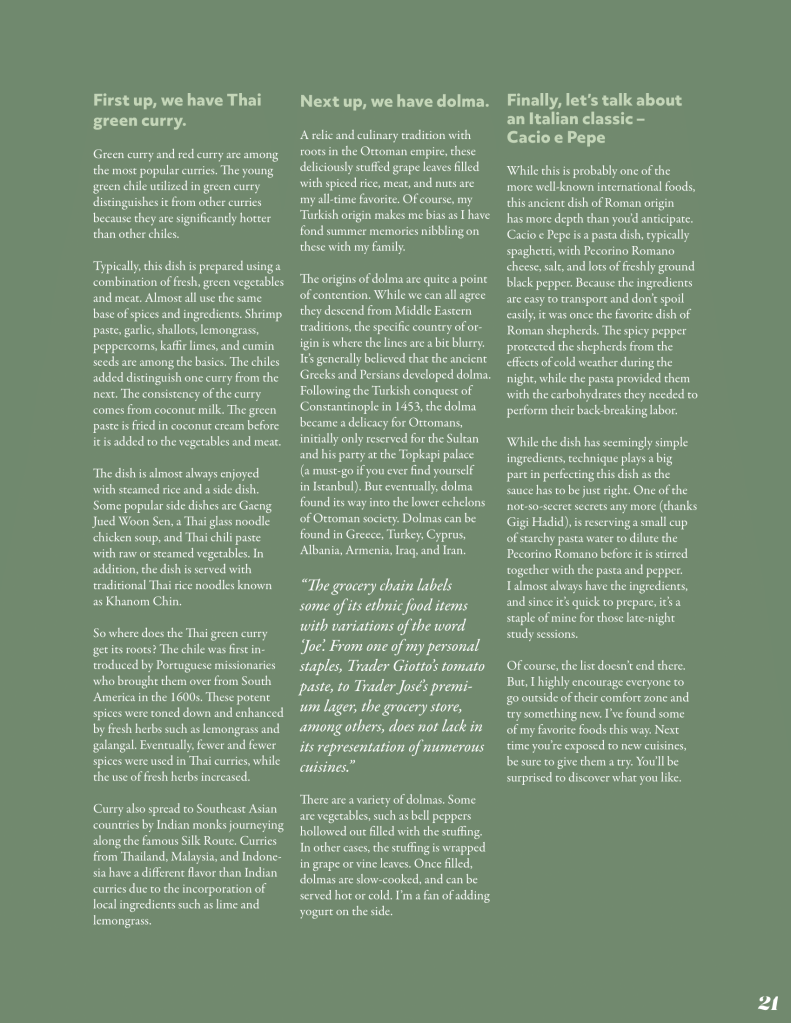
My Piece in The Dish Magazine
To read the entire Spring 2021 issue, click here.

A Review of the Justice in Policing Act
U.S. Congress, Fall 2020, Excerpt from Term Paper
Senator Radis, as we have witnessed, this past year has brought a renewed fervor and activism within the realm of policing reform. The Black Lives Matter movement has garnered a new wave of support and captured the attention of both Americans and our friends overseas. The unlawful killing of George Floyd has subsequently unleashed a series of long-overdue protests addressing the issues of systemic racism and excessive use of force by law enforcement. A new bill, H.R. 7120, the George Floyd Justice in Policing Act of 2020, was introduced on June 8th. On June 25th, the bill passed in the House by a 236-181 vote. It was received by the Senate on June 29th and placed on the Senate Legislative Calendar under General Orders on July 20th. I shall begin by refreshing your memory on the policies of this bill, as well as provide you with the arguments for and against that should arise during debate on the floor. I will then proceed to advise you on a position to take that I believe to be in your best interest regarding this bill.
The Justice in Policing Act is, as stated by the House Judiciary Committee, the “first-ever bold, comprehensive approach to hold police accountable, end racial profiling, change the culture of law enforcement, empower our communities, and build trust between law enforcement and our communities by addressing systemic racism and bias to help save lives” (House Judiciary, 2020). The Justice in Policing Act calls for the establishment of a national standard for the operation of police departments, a mandate of data collection on police encounters, the transformation of existing funds to invest in transformative community-based policing programs, and the streamline of federal law to prosecute excessive force and establish independent prosecutors for police investigations. Amongst others, some of its most contentious provisions include: lowering the criminal intent standard from willful, to knowing or reckless, to convict law enforcement of misconduct in a federal prosecution, limit qualified immunity as a defense to liability in a private civil action against a law enforcement officer or state correctional officer, and authorize the Department of Justice to issue a subpoena in investigations of police departments for a pattern or practice of discrimination. Further, the bill will create a national registry — the National Police Misconduct Registry — to compile data on complaints and records of police misconduct (Bass, 2020).
Those who support the bill will argue it will revolutionize policing. These people likely agree upon the fact that the criminal justice system is embedded with systemic racism that can only begin to be dismantled through a comprehensive legislative initiative such as this one — one that curbs qualified immunity and imposes a ban on chokeholds. This type of legislation is the first step of many we must take to achieve some sort of structural change: the American people are demanding action, and they are not interested in more studies, talking points, or half measures (Congressional Record Senate Vol. 166, No. 120). Black Americans are still not equal in the eyes of many. Polls show overwhelming sympathy for the Black Lives Matter movement and concern about police practices (CQ magazine, 2020). There has been a Republican effort in the Senate headed by Tim Scott to advance a much narrower bill encouraging police departments to revise practices but fails to mandate any permanent change. This bill has offered to restrict chokeholds; gather and publicize data on misconduct by individual police officers, making it harder for a fired officer to find work at another department; and collect data on how often the police kill people (CQ magazine, 2020). However, Democrats argue that this bill centers too heavily on data collection, and not enough on any fundamental legal change that could address police misconduct and use of force (Li Zhou, 2020). Senate minority leader Chuck Schumer has said their bill is “much weaker on nearly every single count and, worse still, is still completely silent on so many issues that scream out for action” (Congressional Record Senate Vol. 166, No. 115). The Republican bill simply pays lip service to the issues we must work tirelessly to overcome.
However, many will likely disagree with the majority of the bill’s propositions arguing it is a federal overreach into policing and damages the noble profession of law enforcement. Some may say that it will deter individuals from pursuing careers in law enforcement and weaken the ability of law enforcement agencies to reduce crime (Edmondson, 2020). Both Mitch McConnell and President Trump have voiced that Democrats “want to take away a lot of strength from our police and law enforcement in general, and we can’t live with it” (Li Zhou, 2020). Representative Brian Fitzpatrick has said on behalf of his Republican colleagues that “we believe that the qualified immunity provision in the bill as it is currently drafted, must be fixed so that we can ensure that we protect our hero police officers both from physical harm and potentially frivolous lawsuits” (Congressional Record House Vol. 166, No. 121). Many will point out that this increase in police accountability may prompt officers to be less aggressive in their policing even at moments when aggression is called for. They will claim crime rates are already growing as officers intimidated by protesters’ criticism have pulled back. (CQ magazine, 2020).
Senator Radis, I strongly encourage you to support the Justice in Policing Act. Putting personal beliefs aside, I think your support for this piece of legislation will prove advantageous in the future. You are new to politics and rely on your constituents to organize politically on your behalf, contribute time and money to campaigns, and ultimately vote for your re-election. Because our main focus is your re-election, it is imperative we meet the needs of your constituents. Thankfully, there are a host of opportunities within the legislative process that we can demonstrate to your constituents you are listening to them. There is, however, a silver lining. Given that this is the beginning of your term, you have some flexibility in focusing on policy right now and more on re-election in your future years. Nevertheless, with the diverse nature of your constituency, we will proceed with caution. I will begin by explaining the theoretical nature of the position we shall take regarding how we will represent Pennsylvanians. I will then turn to a discussion of the likely route this bill will take through the Senate…
(To read the whole paper, please contact me)
References
Bass, Karen. “H.R.7120 – 116th Congress (2019-2020): George Floyd Justice in Policing Act of 2020.” Congress.gov, 20 July 2020, http://www.congress.gov/bill/116th-congress/house-bill/7120.
“Congressional Record Senate Articles.” Congress.gov. Accessed December 10, 2020. https://www.congress.gov/congressional-record/2020/07/01/senate-section/article/S4133-1.
Edmondson, Catie. “House Passes Sweeping Policing Bill Targeting Racial Bias and Use of Force.” The New York Times. The New York Times, June 26, 2020. https://www.nytimes.com/2020/06/25/us/politics/house-police-overhaul-bill.html.
Li Zhou, Ella Nilsen. “The House Just Passed a Sweeping Police Reform Bill.” Vox. Vox, June 26, 2020. https://www.vox.com/2020/6/25/21303005/police-reform-bill-house-democrats-senate-republicans.
“On policing, it’s all politics now.” CQ Magazine (June 29, 2020). http://library.cqpress.com.ezproxy.library.wisc.edu/cqmagazine/weeklyreport116-000005938235.
A Hyperpolarized Media Environment
Intro to Mass Communication, Fall 2020, Media Analysis Essay
The past few decades in United States history have been marked as a period of extreme party polarization and a lack of bipartisanship. Democrats and Republicans are far more ideologically divided than in the past — an issue clearly seen in Congress as the deadlock persists in their inability to get any legislation through or cooperate on any number of policies. We have seen a substantial decline in any ideological overlap between parties: “today 92% of Republicans are to the right of the median Democrat, and 94% of Democrats are to the left of the median Republican” (Pew Research Center, 2014). In addition to these stark ideological divisions is the now deeper, and growing contempt both parties possess for each other. Reaching across the aisle is far more unlikely, and indeed frowned upon. All this to say, mainstream media in the United States not only does not help the country’s divisiveness, but intensifies tensions. Despite their knowledge of potential biases, the public consumes media that most closely aligns to their ideological and political beliefs and pass off other news sources as unreliable and inaccurate. To make matters worse, media commentators, anchors, journalists, and politicians provide a biased view in their narration of current events. As the Harvard Gazette succinctly puts it, “Republicans and Democrats tend to seek out very different news sources so they often get very different information. But even within those sources, the information that’s received is understood differently…” (Pazzanese, 2020). Mainstream media has attributed to today’s highly polarized society by providing politically biased content to their audiences. The public further exacerbates this partisan divide as they heavily consume media that aligns with their political ideology and party. As a result, the public perceives the media as biased against them.
A bias is a preference for one thing over another; it is partiality that prevents the objective consideration of an issue. Similarly, political bias is a preference towards one party or another. It is viewing issues through the lense of your own political beliefs. Political bias is present in almost every form of mainstream media. For the purposes of this argument, mainstream media include major cable news networks such as CNN, Fox News, as well as journals and magazines such as the New York Times and Chicago Tribune. In addition, we consider some social media apps such as Facebook and Twitter. As a result of political bias, the media has a tendency to attract a following of those with similar beliefs, and disengage those with opposing ones. A dangerous result of the political biases of the media is that an individual’s media content is homogenous and typically reaffirms their own beliefs. In turn, there is no room for discourse and debate across party lines. To examine the political bias in mainstream media we first turn to Alessio and Allens discussion in Media Bias in Presidential Elections: A Meta-Analysis. One of the significant findings cited is that fears of partisan bias in the news are not exactly unsubstantiated. On one hand, the journalism industry in general is dominated by people who identify as being more liberal than average. As a result, media coverage and the stories selected to be covered reflect the beliefs and ideology of reporters and editors. On the other hand, however, liberals “find a distinct consevrative bias to the media based in part on the nature of the media as business” (Alessio et al, 2000, 134-135). To substantiate this claim, they go on to explain that although the writers and editors themselves may hold liberal opinions, publishers and business owners “show preferences for conservative viewpoints”. This dichotomy presents two countering viewpoints of political bias in the media.
In addition to the inherent bias of mainstream media, consumers of media also perceive the media as biased — sometimes more so than they are. According to Pew Research Center in 2011, in the 90s only 30% of people believed news stories were inaccurate compared to the 66% in 2011. Along the same lines, in the 90s, 53% of people believed the media to tend to favor one side, in contrast to the 77% in 2011. In more recent years, this has continued. In 2018, 68% or about ⅔ of Americans thought the news media favored one side. If we delve a bit further into the nuances of perceived bias, we see that there are partisan divides on perceived fairness in news coverage. 86% of Republicans think that the media are biased against them in comparison to 52% of democrats. Such statistics align with the responses gathered from my interviewees. According to interviewee R, “the majority of the media is left leaning and portrays the right as monsters”. While he agrees Fox has a slight bias, he claims CNNs bias is way farther left, exemplifying my claim that the public perceives the media as biased against their side. Such a statement from interviewee R also exemplifies the Hostile Media Phenomenon theory. This theory refers to the tendency for people to perceive the media as biased against their side; it’s not just that the media is biased, but that you think it’s going to sway people against your side. (Hernando, R. (2020). Hostile Media Phenomenon. Lecture given at University of Wisconsin-Madison). In the words of interviewee R, “CNN is there to get people angry and filled with hate, whereas Fox is just trying to give you the facts — with a moderate amount of opinion” (Z. Topbas, personal communication, 2020). Hostile media theory can explain this phenomena: interviewee R thinks CNN is trying to sway people against his side.
Furthermore, people are likely to perceive the media as biased because the media strays from their beliefs. This is illustrative of the relative hostile media phenomenon, in which the more extreme your position, the further away the media seems from you. You are also less likely to engage the arguments of the side, and to possibly consider any merit the other side proposes. For example, while researchers find that Fox is only a little to the right, were you to ask a liberal, they would say Fox is ridiculously biased towards the right. Interviewee D states that bias depends on the source you look at. “While CNN has a left bias, the New York Times and NPR are moderate and unbiased” (Z. Topbas, personal communication, 2020). For example, she explains that the concept of wearing a mask has been politicized and CNN discusses the real and harmful effects of COVID-19. On the other hand, Fox uses subjective adjectives to slander people with opposing views and go for emotion in downplaying the importance of coronavirus. Interviewee D’s opinion on perceived media bias is much more neutral and all encompassing. They consider a plethora of media, and evaluate them based on objective conditions with concrete examples. Such responses exemplify Pew Research Center’s data: democrats believe news organizations favor one side less than republicans do. Nevertheless, she still perceives left media as biased against her own side. Once again, this is illustrative of relative hostile media phenomenon: opposing partisans perceive identical news coverage as biased against their own side. Interviewee D believes right leaning news sources are downplaying the coronavirus, while interviewee R believes left leaning sources are blowing coronavirus out of proportion. Ultimately, though there are partisan differences, the majority of people see the media as biased.
A final theory that aids us in our understanding of why individuals perceive the media as biased is The Third Person Effect or Perception. The Third Person Effect is rather simple and quite intuitive: the logic implies that most of us tend to think that the media affects others more than it affects ourselves (Hernando, R. (2020). Presumed Media Influence. Lecture given at University of Wisconsin-Madison). In the words of Davison, in “trying to evaluate the effects of communication, its greatest impact will not be on ‘me’ or ‘you’, but on ‘them’— the third persons” (Davison, 1983, 3). There are multitude of studies that have documented this perceptual gap, and systematically, studies have found that most people tend to think the media affect others more so than themselves. Such results are upheld in the results of my interviews. When asked how much they think they are affected by the media, interviewee R believes he is quite a lot. He considers himself and believes the media has a larger effect on him than it should. “Since the media has been so intense the last few months, especially during quarantine when I was always on my screen, I was more affected”. When asked how much he thinks others are affected by the media, he thinks others are definitely affected, and more so than him. In his eyes, “it has to do with the news sources other people are getting their news from. People who feel the effects are liberal or left leaning because they believe that these news sources are accurate” (Z. Topbas, personal communication, 2020). In this statement by interviewee R, both the third person effect and hostile media phenomenon are reflected: he believes media affects others, particularly those who lean left more so than media affects him. When interviewee D was posed with the same question, her response also fell into line with what was expected of the third person effect — with a bit of a caveat. She states that she is “pretty affected by the media. Most people in western societies are. Media dictates a lot more than people give it credit for” (Z. Topbas, personal communication, 2020). However, where she diverges from the expected findings was how much she believed other people were affected. In her opinion, she is affected by the media just as much as other people. Regardless of being conservatice or liberal, most popular and widely consumed media are left leaning if they aren’t moderate. This falls into line with what Alessio and Allen discuss: the journalism industry is dominated by people who lean left. At the end of Davisons piece, he poses a question: “Why are exaggerated expectations about the effects on communication in others so common?” (Davison, 1983, 14). He offers a counter argument — perhaps we overestimate the effect of others, and underestimate the effect on ourselves. Research has suggested that both of these things happen; we both overestimate it on others but also tend to underestimate it on ourselves. It is then important to take what my interviewees have said, as well as other studies with a grain of salt, and consider them in the context of this third person effect.
Unfortunately, there is no single explanation to explain the phenomenon of media bias in the United States. Rather, it is important to consider bias in mainstream media in two intersecting contexts: one, that the media itself is in fact politically biased, but also that the public perceives them as biased. One could argue that a solution to the dilemma of media bias is to simply eliminate politically biased news sources and ensure all published media is impartial and neutral. Though unlikely, and almost near impossible, were one to completely eliminate politically biased news media, the biases within consumers of media content remain. Or perhaps society as a whole must take the initiative to educate the public about the theories and phenomena of media — something us students have chosen to do by taking this course. Then again, a bit of bias will always remain. While differing ideologies and political beliefs are constructive, and even necessary for a democratic society to function and flourish, today’s polarization is extreme and destructive.
References
D’Alessio, D., Allen, M. (2000, December). Media Bias in Presidential Elections: A Meta-Analysis, Journal of Communication, Volume 50, Issue 4, Pages 133-156, https://doi.org/10.1111/j.1460-2466.2000.tb02866.x
Davison, W. P. (1983). The third-person effect in communication. Public Opinion Quarterly, 47, 1–15.
Gottfried, G. (2018). Partisans Remain Sharply Divided in Their Attitudes About the News Media. Pew Research Center. https://www.journalism.org/2018/09/25/partisans-remain-sharply-divided-in-their-attitudes-about-the-news-media/
Pazzanese, C. (2020. Study finds political bias skews perceptions of verifiable fact. The Harvard Gazette. https://news.harvard.edu/gazette/story/2020/06/study-finds-political-bias-skews-perceptions-of-verifiable-fact/
Political Polarization in the American Public. (2014). Pew Research Center. https://www.pewresearch.org/politics/2014/06/12/political-polarization-in-the-american-public/
 zehratopbas